

Metal Finishes for a Freestanding Pole
Whether you are seeking a freestanding pole to use at home, in the gym or at events, we have a range of options available to you.
The main advantage of a freestanding pole is that you don't need to worry about ceiling joists or vaulted ceilings. It also means that you can move it around without the need to hunt for a joist or buying a lot of extensions to fit a slanted ceiling.
Chrome
Chrome is a superior finish for poles and can be found in numerous pole studios, clubs and in homes worldwide. It's a very sought-after choice because it's the least expensive of all metal finishes and is suitable for all weather conditions. It's also rust resistant, and easy to clean and maintain.
Another aspect to take into consideration is the pole's grip. Some users prefer to use powder-coated poles as they are very sticky which can aid in grip when attempting to execute moves or climb the pole.
In addition, they are also available in a wider range of colours than the traditional Chrome/Brass/Stainless poles. This is ideal for those who prefer one particular color.
The X-STAGE is the most stable freestanding pole dance stage and comes in Chrome, Stainless Steel, Brass, Titanium Gold, Silicone (45mm only in Black & Pink), Powder Coat (Black, Pink & White) and 40mm and 45mm diameters. It is also the most advanced spinning and static pole dance stage around, featuring an uncluttered, sleeker upper dome and X-LOCK, which allows you to switch between spinning and static back in a snap without the need for tools.
The X-Stage is the most secure, safest and most user friendly pole dance stage available on the market. It is also very economical and is constructed from the highest quality materials in the market to ensure you get the most for your money.
It is a web-based productivity app that syncs across devices. It is possible to work from any device you are connected to provided you have an active Google account. After signing in, you can carry on your work exactly as you left it.
This feature can be a huge benefit when you're working from various locations or even at home. With Chrome, you'll access your bookmarks, passwords, and Gmail account at all times.
It also comes with an integrated search box, dubbed the Omnibox. If you type in a URL into the Omnibox it will automatically give suggestions based on what you've previously visited as well as popular websites and search results powered by Google Instant. It also keeps track of your preferences and allows you to easily change the suggestions.
Brass
Brass, an alloy of copper-zinc, was first created in 500 BC. It is a very popular choice for a variety of applications due to its flexibility and resistance to tarnish.
Brass can be used to make numerous products including musical instruments and fire boxes to boiler parts and architectural extrusions. It can also be used to create parts that are durable but also attractive.
Its shiny, golden shine makes it ideal for a variety of decorative uses and it is commonly used to create brass-smithing parts. It can be forged, rolled, or cast into many shapes.
There are three kinds of brass that are duplex, wrought (leaded), and duplex (duplex). The majority of wrought brasses, however, are made from copper and tin. Leaded brasses are made up of up to 3.8 percent by weight of lead and duplex brasses comprise between 37% and 45 percent zinc.
Wrought brasses can be made using a machine or hand. They are usually more flexible than cast brasses. They have high strength and are frequently used to build hinges for gas appliances, hinges radiator valves, pipe fittings.
Many brasses are very soft, but they can be made stronger by hardening them to create beta and alpha brasses. The alpha kind is more durable, has greater cold ductility, and is stronger than the beta. Furthermore, it is less susceptible to dezincification corrosion.
However, it is possible for brass to break under stress, particularly if it is stored in a humid atmosphere or is exposed to substances that release or are contaminated by ammonia. This is referred to as season cracking and is more likely to occur with brass that is stored in a sealed area.
It is recommended to select a freestanding pole made of high-quality materials with strong mounting flanges, as well as threaded steel inserts to help to strengthen the tubing's ends. This will increase the strength of the pole, making it extremely sturdy.
There's a wide assortment of different dance poles available. portable pole dancing pole of poles in Canada are made of chrome or brass. However stainless steel, powder coated poles have become more popular.
Stainless Steel
The stainless steel is a popular material used in poles used in studios and competitions and is available in a variety of coatings. One of the most sought-after is chrome, which provides a slippery surface for dancers to hold onto while they practice their moves. However, this type of coating isn't suited to everyone as it is susceptible to rust.
Stainless steel is resistant to corrosion and can remain in good condition for many years. This is due to its high chromium content, which allows stainless steel to resist an oxidation process while still functioning.
This metal is extremely durable and can be used to serve a variety of needs for medical equipment. This metal is ideal for use in hospitals and other clean and sterile environments because of its strength to corrosion.
It's also extremely resistant extreme temperatures, which means that it can be employed in a variety different applications and environments. It is frequently used in the kitchen to create cookware and other kitchen tools.
Another benefit of stainless steel is the ability to be recycled and eco friendly. This makes it a great choice for a number of applications, and could even help the environment in certain situations.
There are a variety of grades and alloys of stainless steel. The grades and alloys differ in their chemical content as well as their metallographic and functional properties.
The most well-known types of stainless steel are ferritic, austenitic, and martensitic. These metals typically contain at least 10.5 percent chrome. However they can also be made with alloys that include other elements, such as copper and nickel.
These stainless steels are used in diverse industries, including oil, gas and pulp and paper, as well as desalination and chemical. They are also used in a variety of construction projects, such as roofs and facades, rainwater recovery systems, and water pipes for domestic use. They are simple to build and are sturdy and long-lasting. They can last for many years and be altered to suit your individual requirements.
Silicone
Silicone is a strong polymer with a wide range of applications. It can be used in a variety of applications. It is a popular choice for construction and manufacturing projects due to its ability to be molded into a variety of shapes. It is also highly resistant to heat and chemicals, making it a perfect option for a variety of projects.
There are many types of silicone, including acetoxy silicone and natural silicones. All have a similar chemical structure and have no odour, but they vary in their physical properties.
Typically, silicone can be manufactured using a variety of durometers, which are standard hardness ratings. These are used to measure the material's resistance to mechanical stress and range from 10A through 90A.
Durometers are crucial because they can assist manufacturers in selecting the appropriate type of silicone to meet their application requirements. A silicone that has a higher durometer will be more resilient to repeated compression and abrasion.
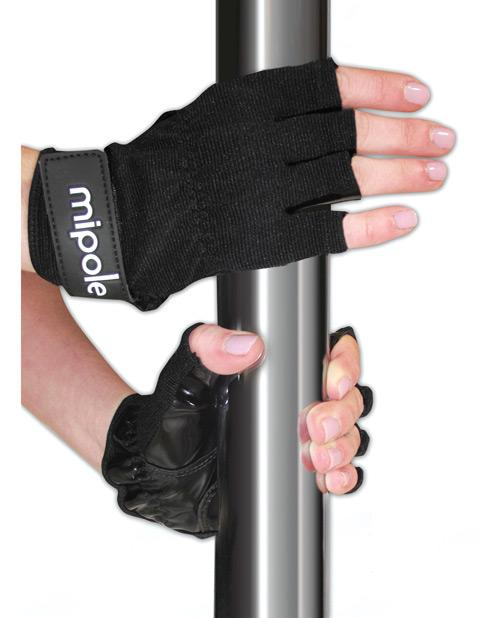
Water resistance is another important quality of silicone. This is vital when using silicone in environments that might contain liquids. This property makes silicone an excellent choice to construct watertight barriers as well as seals.
This is due to the fact that water molecules in the surrounding environment are not able to bond with silicone, which hinders them from getting into closed systems and causing damage to the product. This is an extremely important element to consider when using silicone in construction projects, because it can make an enormous difference in the overall strength and durability of the product.
Silicone is eco-friendly since it is made from renewable resources, making it a better option for the environment than plastic. However, it is not entirely biodegradable and the heating process that is involved in the manufacturing of this material could be considered to be a hazardous process.